9 Sep 2026
Demographic Shifts Among Participants in Web-Based Poker Platforms

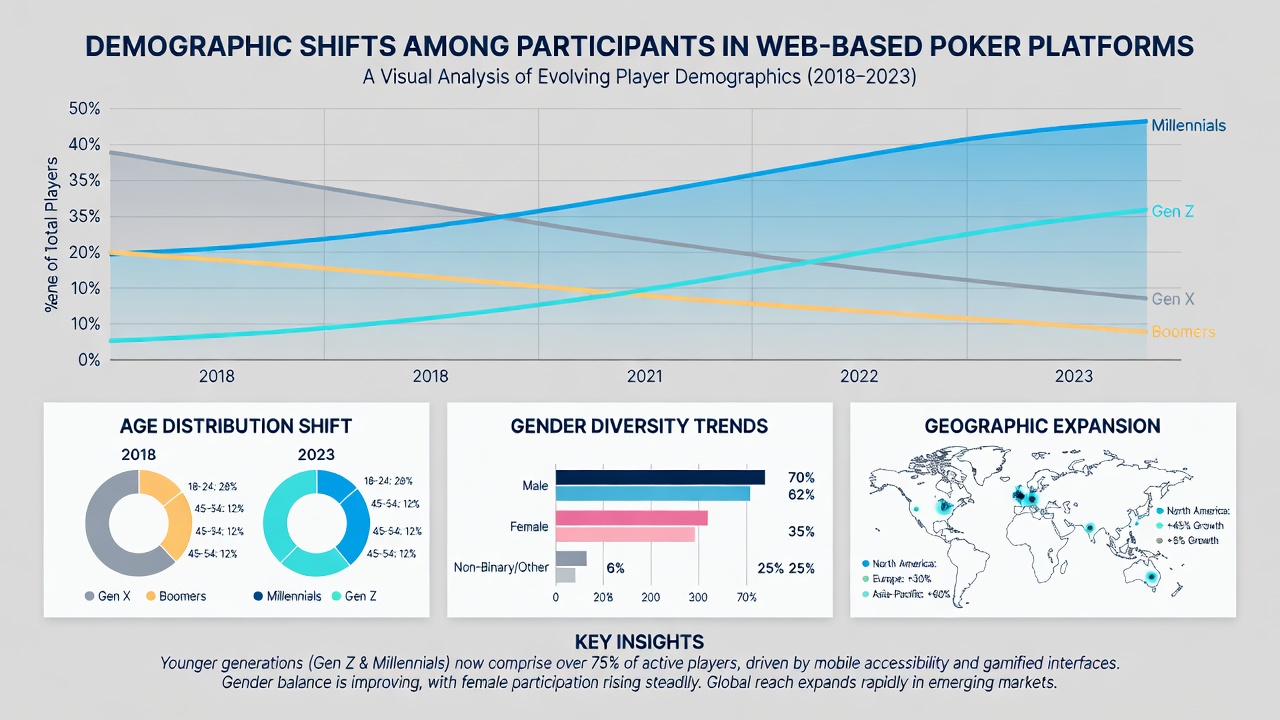
Online poker platforms have seen notable changes in who logs on to play, and researchers tracking these patterns point to broader access through mobile devices alongside evolving regulatory environments as key drivers behind the shifts. Data from multiple jurisdictions shows participation rates rising among groups that were historically underrepresented, while established player bases in certain regions have stabilized or contracted slightly since the mid-2020s.
Age Distribution Patterns
Younger adults between 21 and 35 now account for a larger share of active accounts on major sites, according to aggregated platform data reviewed by industry analysts in early 2026. This group often enters through apps that integrate with social features, and their session lengths tend to be shorter but more frequent compared with older cohorts. Meanwhile players over 55 have maintained steady involvement, though their proportion of total traffic has declined as overall user numbers expanded; studies from academic groups indicate this older segment values established platforms with robust security measures and familiar game variants.
Gender Participation Trends
Women represent a growing segment of registered users, rising from roughly 15 percent of accounts in 2022 to over 22 percent by mid-2026 across several large operators. Observers note that targeted promotions and women-only tournaments have coincided with this increase, while surveys conducted by research institutions reveal that female participants frequently cite convenience and community aspects as primary motivators. Men continue to form the majority, yet the gap narrows in regions where mobile penetration is highest and marketing reaches diverse audiences.
Geographic Expansion and Regional Variations
Participation from Asia-Pacific markets has accelerated notably, with countries such as India and Indonesia contributing larger player pools after local licensing frameworks matured. European markets show mixed results: some nations report stable or slightly declining numbers due to stricter tax regimes, whereas others see growth tied to cross-border platform access. In North America, Canadian provinces that legalized online gaming earlier in the decade experienced sustained interest, and figures released by the Canadian Gaming Association highlight how provincial operators captured a measurable portion of the shift away from unregulated sites.
In September 2026 new regulatory updates in parts of Latin America opened additional markets, and early indicators suggest rapid uptake among 25-to-40-year-olds in those areas. Australian data compiled by government-affiliated research bodies similarly points to increased engagement from regional players who previously faced barriers, particularly after improved payment integrations became available.
Socioeconomic and Device-Related Factors
Income levels among active users span a wide range, yet recent analyses indicate middle-income brackets now comprise the largest share on many platforms, reflecting broader smartphone adoption and lower entry costs through freemium models. Higher-income players often gravitate toward high-stakes cash games and tournament series with substantial prize pools, while lower-income participants tend toward micro-stakes and sit-and-go formats that allow controlled bankroll management.
Device usage patterns further illuminate these changes: mobile sessions now exceed desktop activity by a wide margin on most networks, and researchers at several universities have linked this preference to demographic groups that adopted smartphones as primary internet devices. Tablet usage remains niche but persists among older players who value larger screens during longer sessions.
Platform Features Influencing Shifts
Operators that introduced responsible gaming tools, multi-language support, and localized payment options have attracted more diverse user bases, according to compliance reports filed with various gaming authorities. Loyalty programs and live-stream integrations also correlate with retention among younger demographics, whereas traditional cash-game specialists continue to favor sites with deep player pools and advanced tracking software.
Observers tracking user behavior note that cryptocurrency payment acceptance has drawn participants from jurisdictions with limited traditional banking options, adding another layer to the geographic spread observed since 2024.
Conclusion
Tracking these demographic movements requires ongoing data collection from both operators and independent researchers, since platform policies, regional laws, and technology access continue to evolve. The patterns documented through 2026 illustrate how web-based poker has moved beyond its earlier concentration in specific age groups and locations, reflecting wider digital trends that shape participation across entertainment sectors.